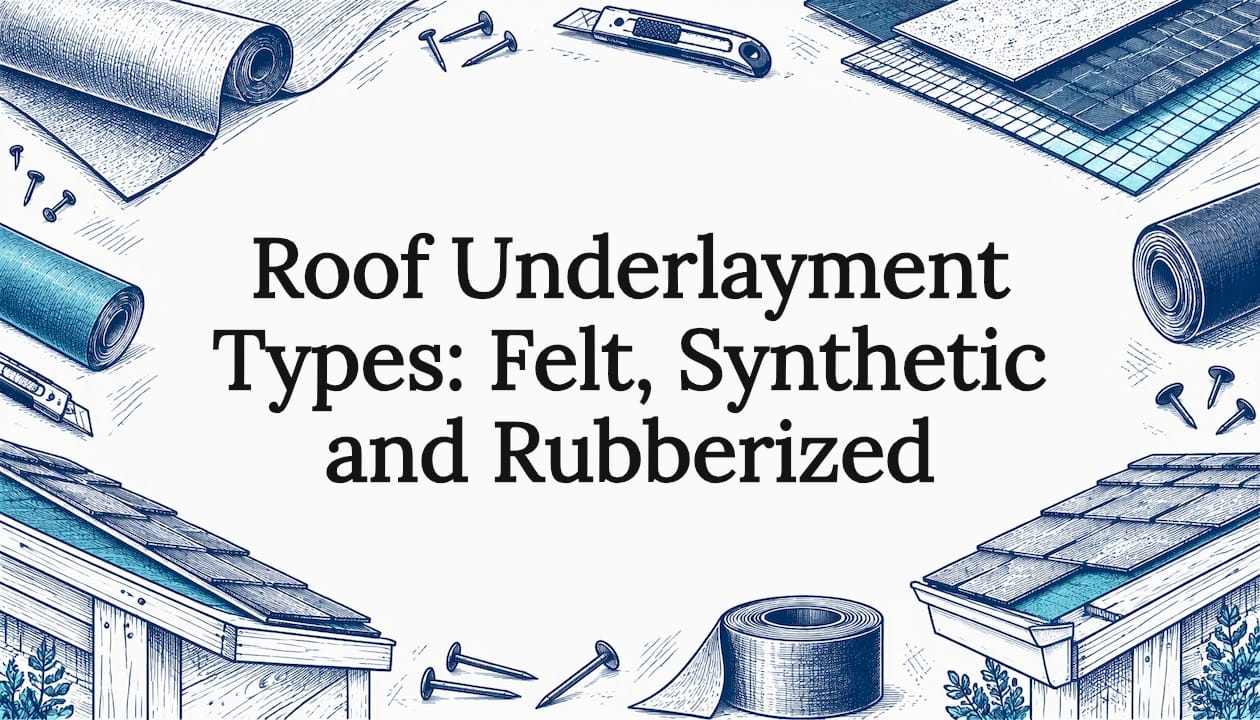
There are three basic types of roof underlayment: asphalt-saturated felt, rubberized asphalt (the peel-and-stick "ice and water shield" type) and non-bitumen synthetic. For most asphalt shingle roofs, a premium synthetic underlayment is the practical choice, with a self-adhering membrane in the spots where water hits hardest, such as valleys and low slopes. Felt still meets code on many roofs and costs less per roll. This guide shows how each type works, what it costs, and how to decide before you sign a roofing contract.
TL;DR
- Felt (#15 or #30) is the traditional, lowest-cost option. It resists water but is not waterproof, and it tears more easily than synthetics.
- Synthetic underlayment is lighter, tougher, slip-resistant and can stay exposed far longer during a job. It costs more per roll.
- Rubberized asphalt is a self-sealing, truly waterproof membrane. It is used in valleys, eaves and low-slope areas, not usually across a whole steep roof.
- Code sets the minimum: #15 felt or an approved equivalent on slopes of 4:12 and up, and extra protection on lower slopes.
- Ask your roofer which product and weight goes on your roof, and get that written into the estimate.
Table of Contents
- What roof underlayment does
- The three roof underlayment types side by side
- Asphalt-saturated felt (tar paper)
- Synthetic underlayment
- Rubberized asphalt (ice and water shield)
- What building code requires
- Which underlayment is best for shingles?
- Everything under the shingles works together
- How to compare estimates on underlayment
- Get a roof quote that names the underlayment
- FAQ
- Sources
What roof underlayment does
Underlayment is the layer between your roof deck and your shingles. Shingles are the part you see, but underlayment is the backup. ARMA, the asphalt roofing manufacturers' association, explains that it adds a secondary layer of protection against wind-driven rain, keeps the deck dry until shingles go on, is a required part of a fire-classified roof assembly, and shields shingles from resins that can come out of wood sheathing.
That last point matters more than most homeowners expect. Fine Homebuilding notes that without a separating layer, asphalt from the shingle can leach into the sheathing, or resins in the sheathing can degrade the shingle. Underlayment also gives your home temporary waterproofing in the days between tear-off and the final shingle going down, which is when a surprise rain shower does the most harm.
The three roof underlayment types side by side
| Feature | Asphalt-saturated felt | Synthetic | Rubberized asphalt |
|---|---|---|---|
| Made from | Organic or fiberglass mat saturated with asphalt | Polypropylene or polyethylene | Rubberized asphalt (bitumen) membrane with adhesive backing |
| Water protection | Water-resistant, not waterproof | Water-repelling, tear-resistant | Waterproof, seals around nails |
| Weight | Heaviest of the rolled products | Light | Heavy, sticky roll |
| Walkability | Can be slick when wet | Usually slip-resistant | Good grip, but hard to reposition |
| Typical use | Standard shingle roofs, moderate climates | Whole-roof underlayment on shingle and metal roofs | Valleys, eaves, low slopes, penetrations |
| Relative cost | Lowest | Middle | Highest per square foot |
The InterNACHI overview of underlayment types sorts the market the same way: felt is water-resistant but not waterproof, rubberized asphalt is self-adhering and seals around fasteners, and synthetics are lightweight, strong, typically non-skid and resistant to fungal growth.
Asphalt-saturated felt (tar paper)
Felt is what roofers used for generations, and it is still common. It comes in two familiar weights, #15 and #30.
What it costs. Fine Homebuilding puts #15 tar paper at about $5 per 100 square feet and #30 at about $10 per 100 square feet. That figure comes from a 2021 article, so treat it as a ratio between products rather than today's shelf price.
Coverage. A standard 3-foot-wide roll of 15-lb. felt covers roughly 400 square feet, while the same-size roll of 30-lb. covers about 200 square feet because it is about twice as thick, according to Fine Homebuilding. Heavier felt is often specified in high-wear, high-water areas such as eaves and valleys.
Where it falls short. Roofing Elements Magazine says felt suits traditional asphalt shingle roofs in moderate climates, that #30 resists tearing better but neither weight does well in windstorms, and that in humid or heavy-rain climates felt may not be the best choice. Felt also has a short exposure window. If rain hits an open felt roof for long, the paper can wrinkle and make shingles harder to lay flat.
A note on the numbers. The "#15" and "#30" labels no longer match actual weight the way they once did. The industry now uses Type I and Type II designations, so ask for the specific product name and its rating rather than just a number.

Synthetic underlayment
Synthetic underlayment is a woven or spun sheet made from polypropylene or polyethylene. It is the type most roofers reach for on new shingle installs today.
What homeowners get from it:
- Lighter rolls and fewer seams to manage. Rolls are thinner and lighter, and Fine Homebuilding adds that synthetics stay more flexible in cold and are more slip-resistant than tar paper.
- Longer exposure. The same source says all synthetic underlayments can be left exposed for at least 60 days, and some for up to a year. That is a real cushion if weather or material delivery delays the shingle phase.
- Durability. Roofing Elements describes synthetic as a significant upgrade over felt because of its durability and resistance to UV rays and moisture, and it recommends premium synthetics rather than commodity-grade ones.
The cost trade-off. Synthetic costs more per roll than felt. Because it is lighter and goes down faster, part of that difference can come back in labor and in fewer tears, but the net depends on the product and the roof. Ask your estimate to name the brand and line, so you can compare like with like.
Product instructions matter. Most synthetics have very low permeance, which makes them effective vapor barriers. Manufacturers generally want them over ventilated spaces such as vented attics, so that the roof can dry downward. That is one more reason the underlayment choice belongs in the same conversation as your attic ventilation.
Rubberized asphalt (ice and water shield)
Rubberized asphalt is a peel-and-stick membrane, often sold under the generic name "ice and water shield." Fine Homebuilding describes it as a heavy bituminous membrane that self-seals around nails, making it a truly waterproof layer. Many building codes call for it in place of building paper on low-slope asphalt shingle roofs.

Ice and water shield vs. felt
The difference is waterproof versus water-resistant. Felt sheds water when it lies flat and stays intact. A self-adhering membrane stays sealed even when water gets under shingles, flashing or around a nail. That is why roofers use it at the places where leaks start: valleys, eaves, chimneys, skylights, pipe penetrations and low-slope sections.
It is rarely put across an entire steep roof because it is the most expensive of the three and it limits how well the deck can dry. Think of it as targeted armor, with felt or synthetic covering the rest.
What building code requires
Codes are the floor, not the goal, and local rules can add to them. Two sources are worth knowing:
- Steep slopes (4:12 and above). Jaspector's summary of the 2024 IRC says asphalt shingles need at least one layer of #15 asphalt-saturated felt or an approved synthetic equivalent.
- Low slopes (2:12 up to 4:12). ARMA reports that codes require a double layer of mechanically fastened underlayment or a single layer of self-adhering underlayment.
- Cold climates. The IRC calls for a self-adhering membrane at the eaves where the average January temperature is 25°F or below, plus a valley liner in every climate zone, per the same Jaspector summary. Your city or county building department can confirm which edition and amendments apply to your address.
Fine Homebuilding also notes that #15 is the minimum required by the IRC and shingle manufacturers, while #30 is required in high-wind zones.
Which underlayment is best for shingles?
For asphalt shingles, the answer depends on your climate, your slope and how long you plan to stay.
- Moderate weather, simple roof, tight budget: #15 or #30 felt can meet code and do the job, as long as the install goes quickly and the roof is not left open to weather.
- Variable weather, storms and heat swings: premium synthetic is the stronger all-around choice. It tolerates exposure, resists tearing in wind and gives crews safer footing.
- Valleys, eaves, low slopes and penetrations: add a self-adhering membrane in these spots regardless of what covers the rest of the roof.
- Metal roof: underlayment under metal sees high roof-deck temperatures and long service life, so product ratings matter. Read our guide to asphalt vs. metal roofing in Central Texas before choosing.
Why Central Texas roofs favor a stronger underlayment
Central Texas roofs face hot summers, sudden heavy rain and hail. Underlayment is your second line of defense when hail bruises shingles or wind lifts tabs. If you are weighing hail-rated shingles, our posts on Class 4 shingles and impact resistant shingles cover the top layer, and the underlayment you pick completes that system.
Everything under the shingles works together
Underlayment only performs as well as what is around it. Three checks make the choice count:
- Deck condition. Underlayment cannot hide soft or damaged sheathing. See OSB vs. plywood roof sheathing for what the deck itself should be.
- Drip edge. The metal edge guides water off the roof and over the underlayment. Here is why your roof needs drip edge.
- Tear-off vs. layover. Underlayment can only be inspected and replaced properly when the old roof comes off. Compare your options in reroof vs. tear-off.
How to compare estimates on underlayment
This is where homeowners can protect themselves, and it takes five minutes. When you gather estimates, look for these lines:
- Product name and type (felt, synthetic or self-adhering), not just "underlayment included."
- Felt weight or product rating, such as Type I or Type II.
- Where self-adhering membrane goes: valleys, eaves, penetrations.
- Shingle manufacturer's requirements, since a warranty can depend on using approved components.
- Deck repairs, including how bad sheathing is priced per sheet.
We always encourage homeowners to get more than one estimate. When every bid names the same underlayment, price differences are real and easy to read.
Our take on underlayment
We see underlayment as the cheapest insurance on the roof. A shingle roof is only as good as the layer that catches what the shingles miss, and in Central Texas that means heat, hard rain and storms.
Our approach is to match the underlayment to the roof, not to a price point. We use durable materials suited to Texas weather, we put the product on the estimate in plain words, and we welcome you comparing our bid with others. That is part of why we stand behind our Best Price Guarantee.
If your roof was damaged in a storm, the underlayment is one of the line items worth reading closely in your insurance scope as well. We can walk through it with you.
Dan
Get a roof quote that names the underlayment
If you are replacing a roof in Central Texas, we offer free estimates, inspections and help with storm damage and insurance claims. Tell us what you have on the roof now and we will explain what we would put under your new shingles and why. Our roofing repair and replacement services page is the place to start.

If an insurance payout is funding the job, our insurance claims help explains how we work with you through the process, so the materials in the scope match the roof you actually need.
FAQ
Is synthetic underlayment better than felt?
For most homeowners, yes. Synthetic is lighter, harder to tear, more slip-resistant and can stay exposed far longer than felt during a job. Felt costs less per roll and still meets code on many roofs, so the better choice depends on your budget, weather exposure and the shingle manufacturer's requirements.
What is the best roof underlayment for shingles?
A premium synthetic underlayment over most of the roof, with a self-adhering membrane in valleys, eaves and around penetrations, is a strong setup for asphalt shingles. Felt is acceptable in moderate climates and on simple roofs. Ask your roofer to name the exact product in the estimate.
Can I use ice and water shield instead of felt on the whole roof?
You can, but it is rarely done on steep roofs because it is the most expensive option and it is waterproof, which limits how the deck dries. Most roofers use it only where leaks start. On low slopes, codes can require it or a double layer of felt, so check local requirements.
How long can underlayment stay exposed before shingles go on?
Synthetic underlayments can generally stay exposed at least 60 days, and some up to a year, according to Fine Homebuilding. Felt has a much shorter window and can wrinkle when wet. Always check the specific product's instructions, and plan your tear-off around the weather forecast.
Sources
- Roofing Underlayment Types, InterNACHI
- Steep Slope Roofing Underlayment, Asphalt Roofing Manufacturers Association
- Choosing Roofing Underlayment, Fine Homebuilding
- Selecting Your Roof Underlayment, Fine Homebuilding
- Underlayment 101, Roofing Elements Magazine
- IRC 2024 Roof Underlayment requirements, Jaspector