Yes, in most neighborhoods with a homeowners association, the HOA can control your roof color, but only to the extent its governing documents say so. Before you pick shingles, find the color rules in your documents, get your color approved in writing, and only then order material. Skipping the written approval is the mistake that leads to fines and tear-outs.
That order of work matters most when an aging roof or a hailstorm forces a replacement on a deadline. This guide walks you through it for a Central Texas homeowner, with notes on how other states differ.
TL;DR
- An HOA can restrict roof color only where its declaration (the CC&Rs) or published guidelines actually say so. Vague wording is harder for an association to enforce.
- Look in three places: the recorded declaration, the architectural guidelines, and any approved color list from the board or management company.
- Get written approval before work starts. A verbal OK or silence from the board is not protection.
- In Texas, a denial must come in writing and you can appeal it to the board. Some metal or wind-and-hail shingle products are protected by state law.
- If insurance is paying for the roof, start the HOA paperwork at the same time as the claim, so the color decision does not delay the job.
Table of Contents
- Why HOAs care about roof color
- Where to find your roof color rules
- Getting approval before you order shingles
- What Texas law says about HOA roof decisions
- How other states handle it
- If the HOA says no, or treats you differently
- Roof replacement after a storm or an insurance payout
- Budgeting for the color decision
- Work with a Central Texas roofer on your replacement
- Our perspective
- FAQ
- Sources
Why HOAs care about roof color
A roof covers a large share of what neighbors see from the street. Associations write color rules to keep a subdivision visually consistent, and courts generally uphold architectural restrictions that serve a legitimate community purpose and are applied evenly, according to a summary of HOA architectural review law.
The rules usually take one of four forms:
- A fixed palette. A list of approved shingle colors, often 4 to 8 choices.
- A general standard. Earth tones, neutral shades, or "colors harmonious with the neighborhood."
- A material rule. Asphalt composition shingles only, or no metal.
- A same-as-existing rule. The new roof must match the old one.
A rule that names colors is easy to apply. A rule that says only "attractive colors" is not, and wording that vague can be challenged. Florida's statute, for example, limits an HOA's review power to what the declaration or published guidelines state or reasonably imply, and requires the association to apply its standards reasonably and equitably. Florida law does not govern Texas, but the principle is common: an association's power comes from its documents.
Where to find your roof color rules
You need three documents, and the roof rule can sit in any of them.
- The declaration of covenants, conditions and restrictions (CC&Rs). This is the recorded document that binds every lot. It says whether an architectural committee exists and that exterior changes need its approval.
- The architectural or design guidelines. The board adopts these to fill in detail: approved colors, materials, profiles.
- The approved color or material list. Often a one-page palette from the board, the management company, or the owner portal.
The association website, owner portal, management company or board secretary can usually provide all three. If your title company gave you a resale packet when you bought, the declaration is in it. Colorado's Division of Real Estate describes these governing documents as the contract between owner and association, which is a good way to think about them: read the whole contract, not just the paragraph a neighbor quoted.
Check for a few specific phrases while you read:
- "Prior written approval" for exterior changes
- A list of approved colors or manufacturers
- A deadline for the committee to respond
- Any rule on replacing "like for like" without review
That last one matters. Some communities let you replace a roof with the same color and material without a full application, but only if the documents say so.
Getting approval before you order shingles
Here is the routine, step by step, with the point where it usually goes wrong.
Step 1: Choose two or three colors, not one
Pick colors from the approved palette if there is one. Choose a first and second choice so a board member's objection does not cost you weeks. If you are weighing how color affects attic heat, our guide to light versus dark shingles covers the tradeoff before you commit.
Where it goes wrong: picking a color from a showroom sample and assuming it matches the palette. Manufacturers name similar shades differently, so match the exact product name and color name to the HOA list.
Step 2: Get the application form and read what it asks for
Use the association's own form. Typical requests include a description of the work, the product name and color, a photo of the house, a sample or color chip, contractor information, and a schedule. Applications for a different material or profile may also need drawings or a site plan.
Where it goes wrong: sending a partial application. An incomplete package restarts the clock, or gives the board a reason to say it never received a proper request.
Step 3: Submit it in a way you can prove
Send it by email with a read receipt, through the portal, or by certified mail, and keep a copy of everything. In Texas, a denial of an architectural request must be delivered to you by certified mail, hand delivery, or electronic delivery, which is one more reason to keep your own paper trail from the start.
Where it goes wrong: relying on a phone call or a hallway conversation with a board member.
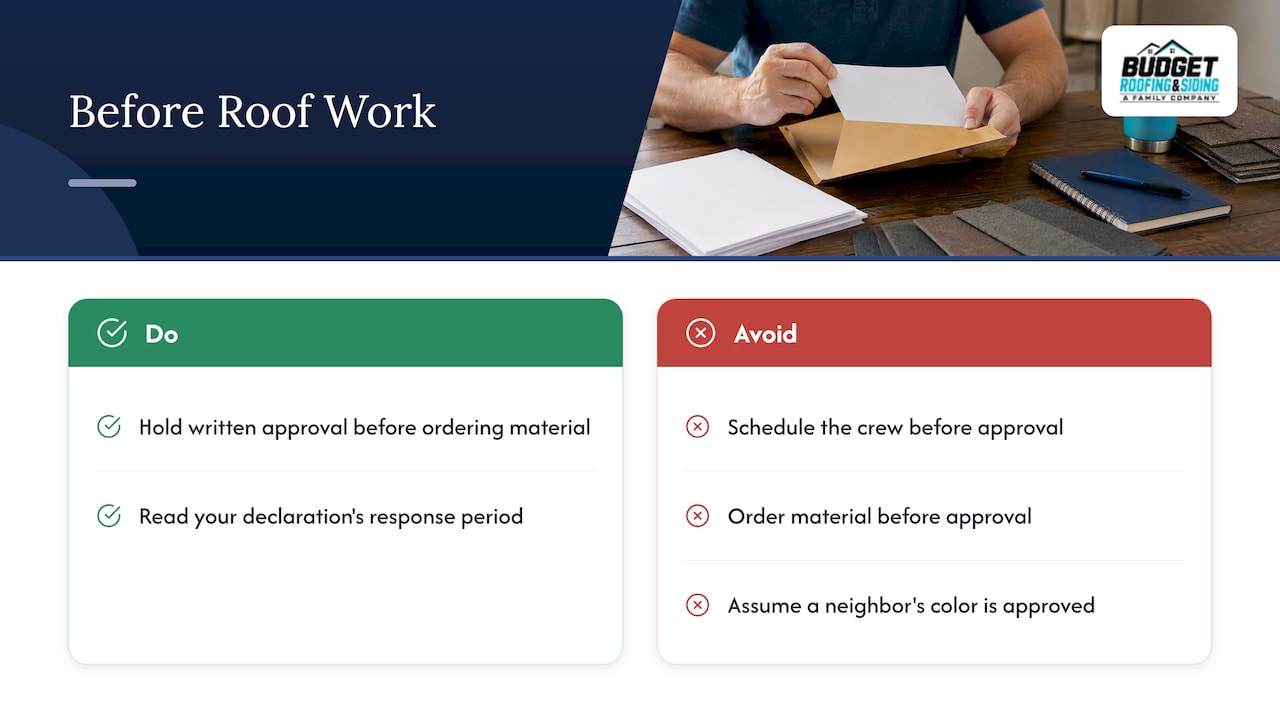
Step 4: Wait for written approval, then order
Do not schedule the crew or order material until you hold the approval in writing. The risk is real: a declaration typically lets the association demand removal of unapproved work, add fines, and recover its legal costs. Some documents deem an application approved if the committee never answers within a stated period, but do not count on that unless you have read it in your own declaration.
Where it goes wrong: assuming that because the shingles look like the neighbor's, the board will agree. Approval attaches to your application, not to a color in general.
Step 5: Keep the approval with your roof records
File the approval letter with your contract and warranty paperwork. It protects you if the board changes, if a neighbor complains, or when you sell.
We have also put together a separate guide on HOA roof approval and avoiding fines if you want the process in more detail.
What Texas law says about HOA roof decisions
If you live in San Antonio or elsewhere in Central Texas, three points matter most.
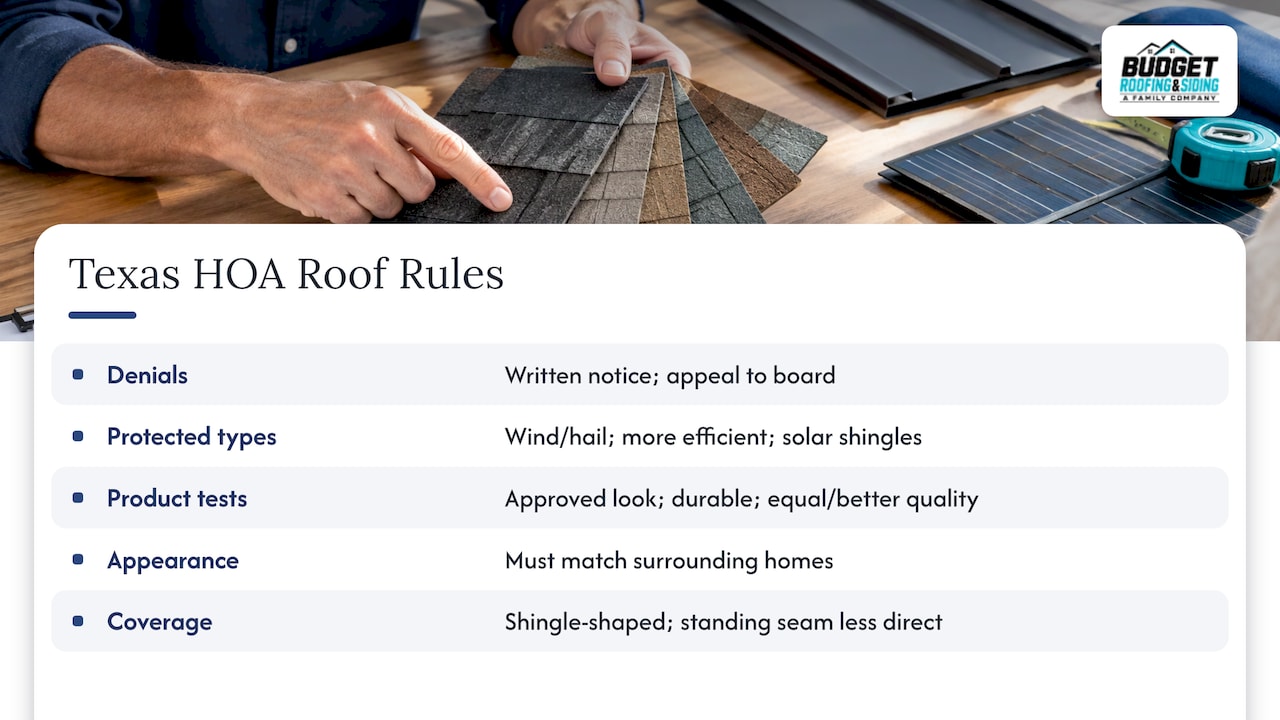
Denials must be in writing. Under Texas Property Code § 209.00505, a decision denying an owner's request to build or change improvements can be appealed to the board, and the written denial notice must reach you by one of the three delivery methods above. The Texas State Law Library's guide to restrictive covenants summarizes this in plain language. If your request is turned down, ask for the denial in writing and read what it says about how to appeal.
Some roofing products are protected. Texas Property Code § 202.011 bars an association from enforcing a rule that blocks a homeowner from installing certain shingles. The protected types are those designed primarily to be wind and hail resistant, more energy efficient than standard composition shingles, or able to generate solar power. The statute's text also sets conditions: the product has to resemble the shingles the subdivision authorizes, be more durable and of equal or better quality, and match the look of surrounding homes. Because the law speaks of "shingles," it most directly covers products shaped like shingles, including metal shingles, rather than standing-seam panels.
The color rule still applies. Even with a protected product, the HOA can reasonably ask that it resemble what the neighborhood already uses. If you are considering metal, ask us about metal shingle profiles that fit your community's look, then bring the product data to the HOA with your application.
This is general information, not legal advice. If a dispute turns on how your own declaration reads, a Texas attorney who handles HOA matters is the right person to review it.
How other states handle it
You may be reading this from outside Texas, or helping a relative who is. State rules differ, so use these as examples, not universal law.
| State | What the law says | Source |
|---|---|---|
| Florida | The HOA's review authority is limited to what its documents state or reasonably imply. A denial must be in writing and name the specific rule and the specific part of the proposal that does not conform. | Fla. Stat. § 720.3035 |
| Colorado | The state's Division of Real Estate advises owners to read all governing documents, keep communication professional and in writing, and consider mediation before litigation. | Colorado DRE |
| Texas | Written denial, appeal to the board, and protected wind/hail-resistant, energy-efficient or solar shingles. | Tex. Prop. Code § 209.00505 and § 202.011 |
Florida adds one more rule worth knowing if you shop for a hurricane-rated roof: its legislature required every HOA to adopt written hurricane protection specifications, and a board cannot deny a conforming application. The Florida Senate's bill analysis explains the measure.
If the HOA says no, or treats you differently
A denial is not the end. Work through it in this order.
- Ask for the reason in writing. A good denial points to the specific rule and what about your request does not conform. A one-line "does not meet community standards" gives you little to answer, and you are entitled to ask for more.
- Compare the rule to what you submitted. Sometimes the fix is as simple as swapping to a palette color or a different profile.
- Photograph comparable roofs. If neighbors have the color you were refused, dated photos help show uneven enforcement. Courts generally treat selective or arbitrary enforcement as a weakness in the association's position.
- Appeal to the board. In Texas this is the step the statute provides after an architectural denial.
- Try mediation before a lawsuit. Colorado's Division of Real Estate notes that mediation and arbitration can resolve disputes short of litigation, and that the prevailing party may be entitled to attorney's fees. Both are good reasons to settle early and keep everything in writing.
A board will often approve a close alternative faster than it will argue a principle. If the goal is a new roof by a certain date, offer your second-choice color.
Roof replacement after a storm or an insurance payout
A hailstorm does not suspend HOA rules. If your insurer pays for a new roof, you still need approval for the color and material before work begins.
Practical sequencing:
- Report the damage promptly. The National Association of Insurance Commissioners advises reporting damage as soon as you know of it and asking about your claim number and any separate storm deductible, in its post-disaster claims guide.
- Have the roof inspected first. The same guide notes that not all damage is visible from the ground, so an inspection helps you decide whether a claim makes sense. Our guides to storm damage roof inspections and steps to take after hail damage lay out what to photograph and when.
- Know how your payout is calculated. The NAIC explains that an actual cash value policy deducts depreciation, which can leave an older roof with a much smaller payment, while replacement cost coverage pays to repair or replace without that deduction. Knowing which you have tells you how much room you have to choose a roof color or material.
- Start the HOA application while the claim is open. The approval letter then does not hold up your start date once funds arrive.
If your claim is denied or underpaid, see our six-step appeal roadmap. For what a policy may leave out altogether, read about roof exclusions in homeowners insurance.
Budgeting for the color decision
Color rarely changes the price of asphalt shingles. Material does. A palette that limits you to one product line, or a rule that bars metal, can shift your estimate more than any shade choice. That is why we encourage homeowners to collect more than one estimate, and why you should give every contractor the same HOA-approved color and product list so the bids can be compared line by line. Our Best Price Guarantee is built for that comparison.
Work with a Central Texas roofer on your replacement
Budget Roofing and Siding handles roof repairs and full replacements for homeowners in Central Texas, including asphalt shingles and metal roofing, along with storm damage restoration and free estimates. We also guide homeowners through insurance claims and stand behind our Best Price Guarantee.
If you have your HOA's color list in hand, we can quote a roof using approved colors and products. See our roofing services, or learn how our insurance claim help works if a storm is behind the replacement.

Siding and fascia or soffit work on the same house may also need HOA review, so it is worth sending those requests together. Our siding page lists what we repair and replace.
Our perspective
Most HOA roof headaches we hear about are not about taste. They come down to timing. A homeowner gets a storm-damaged roof, a crew is available, and the application goes in after the shingles are ordered. Then a color question turns into a stalled job.
Our advice is simple. Read the documents first, pick colors from the approved list, and get the approval in writing before anything is ordered. Then compare estimates using the same color and product on each bid. A fair price only means something when every contractor is quoting the same roof.
We build our work around Central Texas weather and around homeowners who want straight answers: what the roof needs, what the insurance process involves, and what the job should cost. That is why we back our work with a Best Price Guarantee and why we help you through the claim.
Dan
FAQ
Can my HOA make me change a roof color I already installed?
If you installed it without required approval, the declaration generally lets the association demand correction and add fines or fees. If you had written approval, that letter is your protection. Gather your documents and speak with a Texas attorney if the board disputes it.
Can an HOA tell me what color to paint my house?
Yes, if your documents require approval of exterior colors. Many associations publish approved paint palettes and require an application for anything outside them. The same steps apply: check the documents, apply in writing, wait for written approval.
Can an HOA ban metal roofs?
It depends on the wording. A clear rule limiting roofs to asphalt shingles is likely enforceable, but Texas Property Code § 202.011 protects certain wind-and-hail-resistant, energy-efficient or solar shingles when they resemble the approved look. Standing-seam panels are less directly covered, so read your declaration closely.
How long does HOA roof approval take?
The time is set by your own documents, often a few weeks. Check the declaration for a stated response period and submit a complete application so the clock is not reset. Start before your contractor's schedule opens up.
Do I need HOA approval if insurance is paying for the roof?
Yes. Insurance pays for the repair, but it does not replace the association's review. Apply for approval while the claim is still being processed.
Sources
- Enforcing Conformity: Home Improvement Projects and Architectural Review Boards
- Florida Statutes § 720.3035
- Colorado Division of Real Estate: Living in an HOA
- Texas Property Code § 209.00505
- Texas State Law Library: Restrictive Covenants
- Texas Property Code § 202.011
- Florida Senate bill analysis, CS/SB 600 (2024)
- NAIC Post-Disaster Claims Guide